



Are you looking for the right hiring manager to help your company grow?
Choosing the right person for this role matters more than you might think, as studies show that 75% of voluntary employee turnover is linked to poor management.
That’s why finding a hiring manager who can spot great talent and build strong teams is one of the most important decisions your company will make.
In this article, we’ll show you how to find a hiring manager and share practical tips to make the process easier and more effective.
What is the role of a hiring manager?
The hiring manager (talent manager) plays a strategic role in shaping an organization’s overall approach to attracting, hiring, and retaining top talent.
They work closely with department leaders to identify workforce needs, develop effective job descriptions, and ensure a consistent, high-quality candidate experience across all roles. Today, talent managers focus on driving organizational growth by:
- Partnering in workforce planning and forecasting future staffing needs
- Strengthening employer branding to attract the right candidates
- Ensuring fair, compliant, and inclusive hiring practices
- Enhancing employee engagement and retention through strategic talent initiatives
What makes a great hiring manager?
The difference between an average manager and an exceptional one often comes down to soft skills and leadership qualities, not just technical know-how.
Here are the key traits that define great talent managers:
🟢 Communication – Clear, consistent communication is the foundation of effective management. The ability to listen actively, provide meaningful feedback, and articulate goals ensures alignment and trust across the team.
🟢 Decision-making – Sound decisions come from balancing input, analysis, and intuition. The best leaders stay calm under pressure, assess their options, and act confidently to keep progress moving forward.
🟢 Empathy and emotional intelligence – Understanding and acknowledging individual perspectives builds stronger team relationships. A manager who demonstrates emotional awareness fosters trust, reduces conflict, and creates a more supportive work environment.
🟢 Leadership and motivation – True leadership is about inspiring action, not just managing tasks. By setting the right example and recognizing each person’s potential, a manager can energize their team and drive meaningful results.
🟢 Accountability and integrity – Taking ownership of outcomes—both good and bad—sets the tone for the entire team. When leaders act with honesty, follow through on commitments, and hold themselves accountable, they earn lasting respect.
🟢 Adaptability – Change is constant, and successful managers know how to adjust without losing focus. Flexibility, resilience, and a willingness to innovate help teams navigate uncertainty with confidence.
4 Strategies to build a strong hiring process for hiring managers
Hiring a talent manager requires a structured approach to find the right fit. Below are 5 strategies for recruiters and hiring teams to effectively hire a manager, from planning through onboarding:
1. Consider internal candidates or an external search
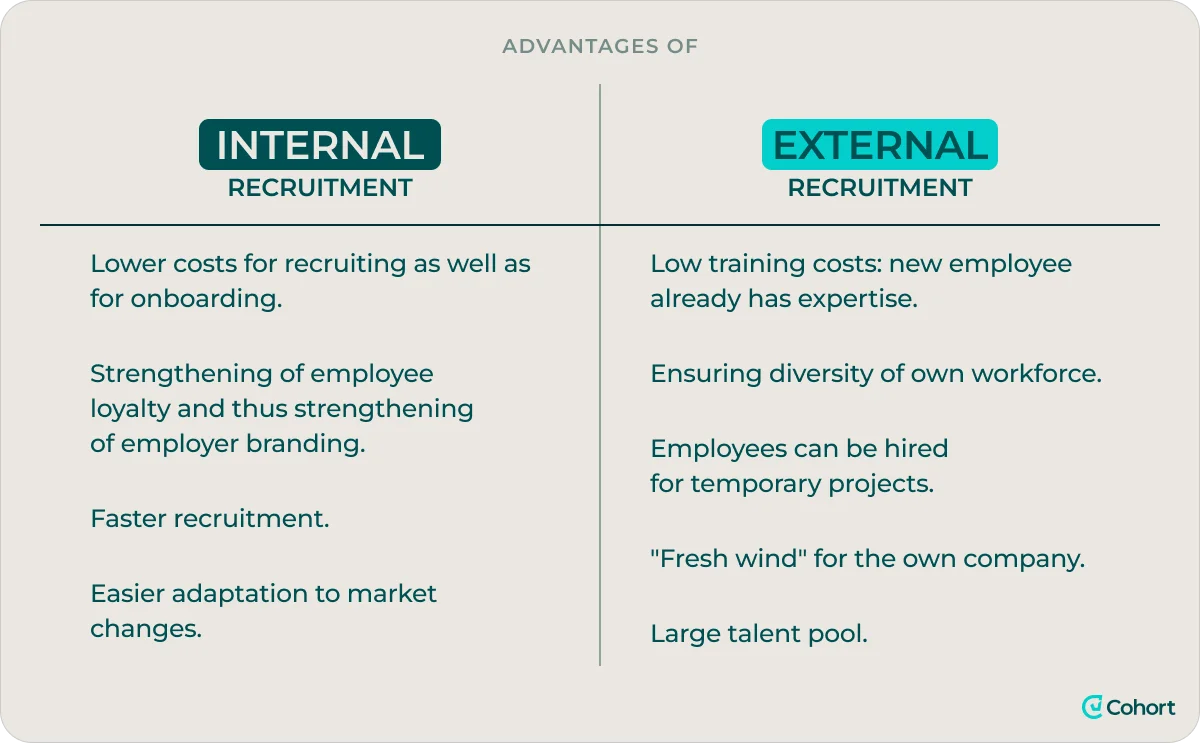
When filling a role, the first decision is whether to recruit internally, externally, or both. Each approach has unique advantages, and the right mix depends on your organization’s goals, culture, and talent pipeline.
✅ How to make it work:
- Promote from within: Internal candidates already understand your culture, systems, and processes, saving time and onboarding costs. In fact, they are 70% more likely to remain with the company long-term compared to external hires.
- Assess internal mobility: Identify high-potential employees ready for advancement. Organizations that prioritize internal mobility see up to a 25% increase in staff retention.
- Expand externally when needed: External candidates bring new perspectives and specialized skills that may not exist internally. This can drive innovation and prevent stagnation, especially in rapidly evolving industries.
- Balance your talent pool: Many organizations consider both internal and external candidates to find the strongest hire. Clearly communicate opportunities and invite internal referrals to build trust and engagement across the team.
2. Craft a compelling job description and posting
Many job descriptions are overly generic or optimistic, resulting in misaligned expectations. In fact, 36% of new hires who quit within three months say the job didn’t match what was described.
That’s why creating a clear, detailed, and honest job description is your first opportunity to attract the right candidates while discouraging poor fits.
✅ How to get it right
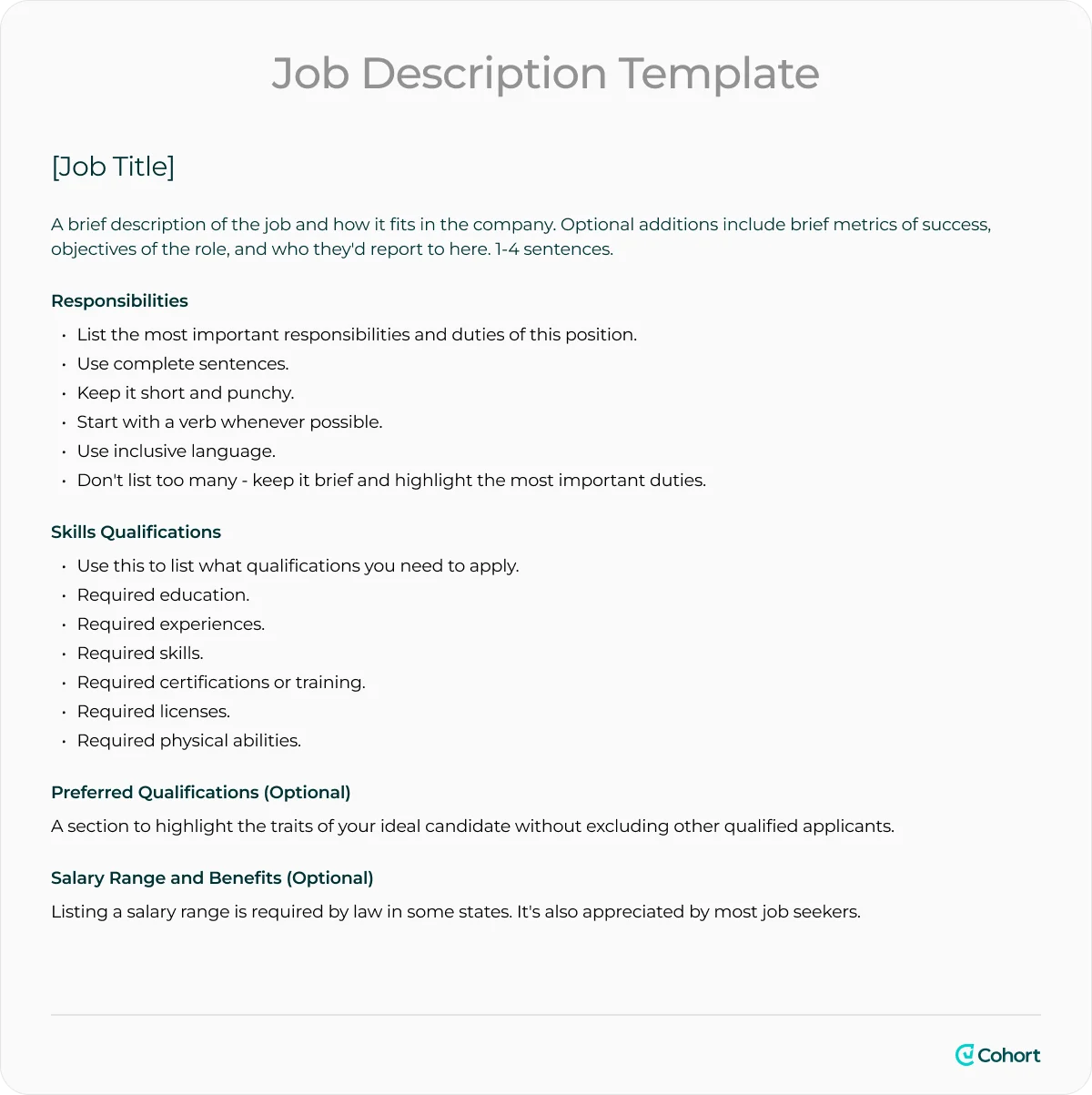
- Define the essentials: Start by clearly outlining the job title, main responsibilities, and required qualifications, such as education, years of experience, and technical skills. Keep it specific and organized, as clarity at this stage helps candidates quickly determine if they’re a genuine match.
- Show authenticity: Be transparent about the realities of the role, not just the highlights. If the position involves rebuilding a struggling team or managing difficult transitions, it’s better to say so up front to attract candidates who are prepared and motivated for that challenge.
- Highlight your culture: Give candidates a glimpse into your company’s mission, values, and team dynamics. This helps them visualize what it’s like to work with you and decide if they align with your organization’s way of thinking and collaborating.
- Add the “what’s in it for them”: Don’t just list duties, share what makes the role rewarding. Highlight career growth opportunities, the impact they’ll have on the business, and benefits or perks that show you value their contribution.
- Be transparent about pay: Candidates expect upfront honesty when it comes to compensation. Since 47% of job seekers prefer to see salary details in postings, including a range helps attract talent at the right level and builds credibility.
3. Source candidates and pre-screen
Finding great talent managers starts with smart sourcing and efficient pre-screening. With competition rising and talent harder to find, a clear strategy helps you attract and identify top candidates faster.
✅ How to make it work:
- Use multiple sourcing channels: Don’t rely on one platform. Combine job boards, professional networks (77% of recruiters use LinkedIn for hiring), recruitment agencies for niche roles, and outreach to passive candidates.
- Leverage employee referrals: Referrals remain one of the most reliable sources of quality hires, as 82% of employers use them because referred candidates are often pre-vetted and culturally aligned. Promote openings internally and offer referral bonuses to boost participation.
- Expect high application volume: A single corporate job post can attract around 250 applicants. Without the right tools, screening can become overwhelming and slow down the process.
- Automate your screening: Use an Applicant Tracking System (ATS) or pre-screening tools to filter resumes by keywords, skills, and experience. This speeds up the shortlist process and ensures no qualified candidate slips through.
- Add a quick pre-screen step: Set up short phone screens or questionnaires focused on must-have criteria, like management experience or industry background, to narrow the list efficiently.
4. Conduct structured interviews
Unstructured interviews can easily lead to bias and inconsistent hiring decisions, especially for management roles where leadership style and judgment are critical.
Casual “chats” might feel natural, but they often rely on gut instinct rather than objective evaluation.

Research shows that unstructured interviews only account for about 14% of variance in job performance, compared to structured interviews, which may reach roughly 57%.
✅ How to make it work:
- Standardize your process: Plan a structured interview format with consistent questions and scoring criteria for every candidate. This promotes fairness and reduces bias, as 72% of employers now use structured interviews to improve hiring equity.
- Ask behavioral questions: Focus on a candidate’s past experiences to gauge real-world management skills. For example, asking about handling an underperforming employee or overcoming a team challenge reveals communication, problem-solving, and emotional intelligence
- Include situational scenarios: Use hypothetical questions to explore how they’d handle common management dilemmas. This helps evaluate their judgment and approach to leadership.
- Skip the cliches: Avoid overused questions like “What are your strengths and weaknesses?”, as they often produce rehearsed answers with little insight. Instead, explore leadership competencies and how they align with your company's values.
🧠 Example: NextRoll
NextRoll, a technology-driven marketing and data company, realized its unstructured interview process led to inconsistent and biased management hires. Here’s how they improved it:
- Standardized interviews with consistent behavioral and situational questions across all candidates.
- Trained interviewers to use clear scoring rubrics and evaluation criteria to ensure fairness.
- Used structured interview software to guide interview flow and capture objective feedback.
🟢 Result: NextRoll significantly reduced bias, improved hiring consistency for leadership roles, and enhanced the candidate experience.
How to find hiring managers on LinkedIn
If you’re recruiting for hiring manager roles, LinkedIn is one of the best tools to identify and connect with qualified professionals. With the right search filters and messaging approach, you can quickly build a pipeline of experienced candidates who fit your hiring needs.
1. Use specific job titles in search
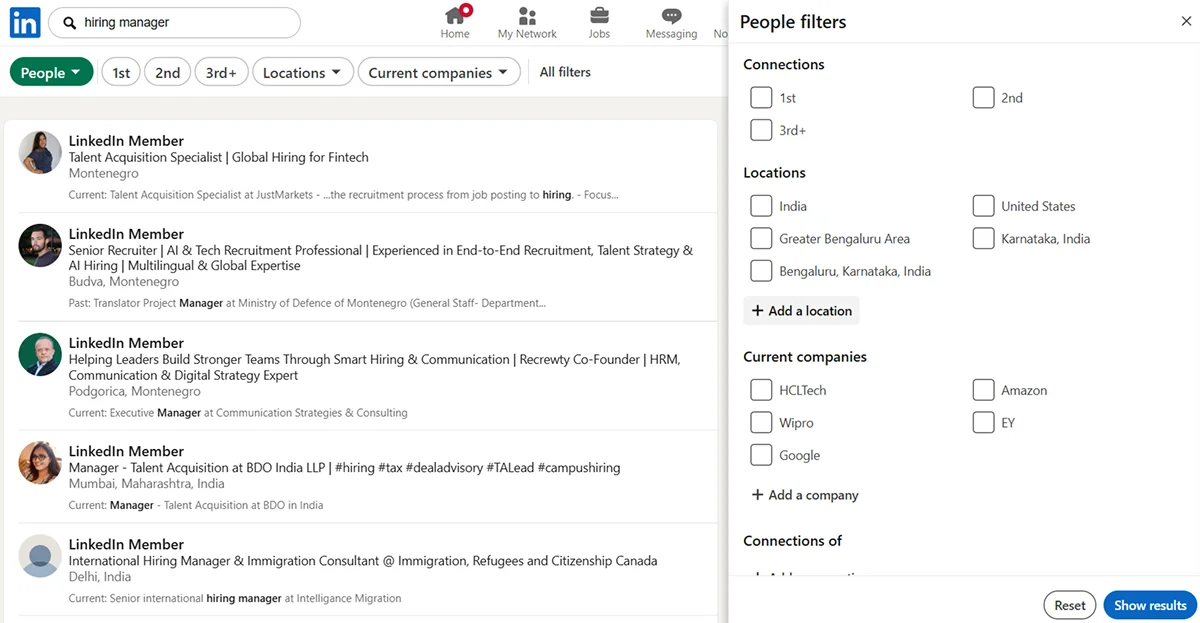
Start by typing relevant job titles, such as “Hiring Manager,” “Recruiting Manager,” “Talent Acquisition Manager,” or “HR Business Partner,” in the LinkedIn search bar.
Then, select “People” to focus only on individual profiles rather than companies or content.

This approach helps you surface professionals who currently hold, or have recently held, roles directly tied to managing recruitment.
2. Filter by location and industry
Once you have an initial list, use LinkedIn’s filters to narrow down by city, region, or country, depending on where you’re hiring. You can also select industries that align with your company’s sector or the one you’re recruiting into.
3. Search by current or past company
If you know which organizations produce strong hiring leaders, use the “Current Company” or “Past Company” filters.
This allows you to identify professionals with experience in specific corporate environments, whether large enterprises, fast-growing startups, or niche firms.
4. Leverage Boolean search
For more precision, use Boolean operators such as ("hiring manager" OR "recruiting manager") AND "talent acquisition" AND "New York".
Boolean searches help you find profiles that include multiple relevant keywords, increasing the likelihood of discovering ideal candidates.
This method is especially useful when recruiting across multiple titles or overlapping HR roles.
5. Explore related roles
Not every qualified professional will use “Hiring Manager” as their official title, as many perform similar duties under roles like “HR Manager,” “Recruitment Lead,” or “People Operations Manager.”
Broaden your search to include these variations for a more comprehensive candidate pool.
6. Use LinkedIn Recruiter or premium tools
If you have access, LinkedIn Recruiter and Premium offer powerful filters, including years of experience, skills, and seniority level.

These tools allow you to refine searches, save candidate lists, and send personalized InMail messages directly. They also provide insights into candidate activity and response likelihood, helping you prioritize outreach.
💡 Pro tip
Instead of manually searching, LinkedIn Recruiter alternatives like Cohort AI simplify that process with intelligent automation.
With Cohort AI, you can:
- Manage your entire hiring funnel in one place.
- Automate outreach, screening, and engagement with built-in AI agents.
- Receive pre-vetted, top candidates in as little as 3 days.
- Eliminate tool-hopping, make faster decisions, and reduce candidate drop-offs.
Sally the Sourcer, your always-on talent scout, scans millions of profiles across LinkedIn, GitHub, and proprietary datasets to keep your pipeline filled with qualified candidates.
Cohort AI finds the best fit based on your predetermined criteria, saving you up to 20–30 hours a week on manual sourcing, eliminating tool-hopping, and helping you make faster, smarter hiring decisions.
Common mistakes when hiring a manager and how to avoid them
Even experienced recruiters can stumble in the process of selecting a new manager. Here are some frequent mistakes to watch out for and how to prevent them:
1. Unclear role definition or expectations
Hiring the wrong person often begins with a lack of a clear understanding of your needs. Taking time upfront to clarify the role’s responsibilities, required skills, and success criteria ensures you set realistic expectations and attract candidates who truly fit.
2. Overlooking cultural fit and soft skills
Focusing solely on a candidate’s resume and hard skills can backfire if they lack the skills to lead a team.
By assessing soft skills just as rigorously, through behavioral questions and involving team members in the interview, you’ll find someone who aligns with your culture and strengthens it.
3. Poor interview techniques and biases
Many hiring mistakes happen during interviews due to unstructured formats or personal bias. Gallup reports that companies fail to choose the right manager 82% of the time because of flawed selection practices.
Using structured, job-relevant questions and predefined evaluation criteria helps interviewers stay objective and choose based on evidence rather than instinct.
4. Rushing or dragging out the hiring process
Time pressure can cause recruiters to rush or delay, both of which can cost great candidates. In fact, 34% of candidates feel “ghosted” if they don’t hear back within one week.
Striking a balance (moving efficiently while maintaining clear communication and thoughtful evaluation) helps secure top talent without compromising on quality.
5. Neglecting reference checks and onboarding
Skipping reference checks or failing to onboard properly can undo all your hiring work. Studies show that employees who go through structured onboarding are far more likely to stay. Consistent reference calls, clear 30–90 day goals, and early mentorship ensure your new manager feels supported and sets the stage for long-term success.
Ready to find the perfect talent manager? Let Cohort AI help
Cohort AI integrates generative AI into everyday recruiting workflows, from sourcing and assessment to personalized engagement and matching, enabling hiring teams to recruit smarter, communicate more effectively, and scale their efforts without increasing headcount.
Powered by SPEC, our system of AI agents that manage sourcing, outreach, screening, and engagement, Cohort AI acts like a 24/7 recruiting operations team, running quietly in the background to boost efficiency, reduce bias, and accelerate every part of the hiring process.
Each search is supported by a dedicated Talent Architect, who captures the nuances of your requirements to deliver candidate recommendations that are accurate, relevant, and tailored to your organization.
How Cohort AI helps you:
🟢 Dedicated Talent Architect support – Each search is guided by a Talent Architect who captures the nuances of your requirements to deliver candidate recommendations that are accurate, relevant, and tailored to your organization.
🟢 Smarter talent sourcing – Discover high-potential candidates by focusing on real skills and achievements, not just what’s on a résumé.
🟢 Simplified assessments – Conduct on-demand, role-specific interviews scored against clear success criteria for fair, consistent evaluations.
🟢 Personalized outreach – Send AI-tailored messages that reflect your brand voice and attract top talent.
🟢 Stronger engagement – Automate follow-ups and FAQs to keep candidates informed and reduce drop-offs.
🟢 Intelligent matching – Match candidates to roles based on skills, behaviors, and working styles, understanding how they work, not just where they’ve worked.
🟢 Talent graph + LLM matching layer – Builds a comprehensive candidate graph from both public and proprietary data, enabling intelligent matches based on patterns, potential, and context, not just keywords.
🟢 Talent data management – Continuously ingests, validates, and enriches candidate data from multiple sources to maintain a high-quality, up-to-date talent database.
Book a demo today and experience how Cohort AI makes finding and hiring the right people faster, smarter, and simpler.


